Welcome to my little blog. I hope you find it as rewarding, provoking, and infuriating to read as I find it painful, arduous, and satisfying to write. Plain Tales From The Weald is the ramblings of a cantankerous old curmudgeon, written from the Olympian perspective of someone long since grown too old, weary, and canny to be fooled again by any revolution or constitution, new or old. [For more details about the author, see Robin Goodfellow – His Life and Crimes.]

I think of this blog as a series of ‘essais’ (“a merging of casual anecdotes and autobiography with intellectual insight” – Wikipedia), after Michel de Montaigne (1533 –1592) who invented the form and is one of my most admired writers. An essay is a trial, an experiment, and no one should think these pieces are the finished article. I am learning my craft, and these are but the clumsy attempts of an apprentice. Nor, of course, would I presume to any but the most unfavourable comparison with Montaigne, except to echo his family motto.

A word of explanation about the title is relevant. The Weald is a hilly region of largely rural land that runs roughly West to South East across southern England (the underlying geology continues across the Channel and into North West France). It is a land where no road runs straight or level for 100 metres, making a secretive, intimate landscape.

The Weald is the eroded remains of higher hills (an anticline) which were raised by the same tectonic collision that formed the Alps. I mention this because it is the geology that has helped protect the area from the blights of urbanisation and large-scale agribusiness, and given the Weald its unique and very pleasantly bucolic character.

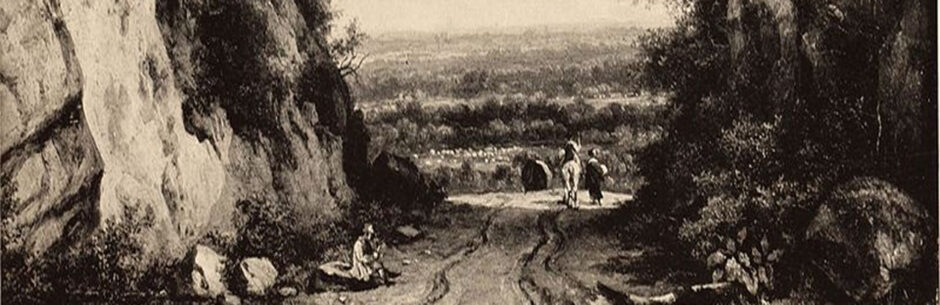
The Weald is a corrugated, crumpled landscape of many small hills, where narrow lanes, often deeply sunken, twist and turn about on their way to people and places long since vanished and forgotten.
Alternating bands of clay and porous sandstone made it a land of streams and rivers, and also determined the pattern of roads and settlements. The streams tend to run in steep-sided gullies known as ghylls, and the old roads followed contours to avoid becoming flooded and impassable. Hamlets accreted on islands of foundation stone amongst the clays where ancient tracks met, hence so many places named something-Cross.

The small, irregular fields whose boundaries are marked by almost equally-sized stands of fine old trees (known locally as shaws) and ancient hedgerows, were carved out from the forest along lines dictated by the very geology of streams and soil. The ridge of the High Weald, bounded by the great chalk escarpments of the North and South Downs, also made the construction of railways and roads to London difficult and expensive, preventing the colonisation of the area by commuters. [See, Why The Weald Looks Like The Shire]

But don’t imagine the Weald was some unproductive wilderness. The combination of accessible iron ore with plentiful wood for fuel and streams for power made the area an important source of iron since pre-Roman times, right through to the late 18th century. Kipling, in Puck Of Pook’s Hill, a now sadly neglected children’s book telling the history of the Weald spins a yarn about smugglers and cannon forges in the Weald.
Little trace of all that industry remains, apart from the road names. Within three miles of my home are two Furnace Lanes, a Hammer Lane, a Cinderford Lane, and any number of something-Mill lanes. Mind you, we also have a Dumb Woman Lane, a Brown Bread Street (a hamlet, not to be confused with the nearby Whitebread Lane), a Ragged Dog Lane, and a Foul Mile (not that bad, really), a Straight Half Mile road (neither, actually), not to mention several Cackle Streets (also hamlets) just a few miles apart. Just a little further south you can find yourself on Terrible Down Road, although I can’t see what’s so wrong about it. Another local habit is using the same names over again. As well as the aforementioned Furnace and Hammer lanes and Cackle Streets, there are three Broad Oaks (villages) within ten miles of each other. All this must create great confusion for the post office and the authorities; which is, perhaps, the purpose.
But after the iron industry moved to be near supplies of coal, not to mention transport links, the Weald settled down to a retirement (and indeed as many retirement homes) as a rural backwater. Spared the needs of combine harvesters and cattle trucks, the landscape is richly ornamented with magnificent trees. Indeed, there’s scarcely room for the people, so intertwined are the trees with the very bones of the landscape, and as someone who loves trees above all other plants, that seems to me to be about the right balance.

At its southern edge the Weald runs down to the sea, past the big skies and waterlands of Pevensey Marshes, and between raised land that stretches out like the fingers of a hand to the cliffs of Beachy Head, Hastings and beyond. The whole Weald, from its proximity to the coast and therefore to France, was long notorious as a haunt of smugglers, or ‘Owlers’ as they were known locally. (For more about Hastings, see Ferns, Fossils, Fauna And Inspiration, Hastings Country Park, in The Scientific Tourist Blog)
And living in the Weald does inspire a somewhat Olympian detachment. It is, on the whole, a wealthy place, insulated from the pressures of industry and commerce. The Weald, like the Cotswolds, epitomises the ideal English countryside as imagined by foreigners and natives alike. It is, to some extent, a relic of a long bygone way of life that, perhaps for the most part, only existed in an urban imagination; pleasant, peaceful, gentle and genteel, prosperous without being ostentatious. ‘Far from the madding crowd’s ignoble strife‘ of the modern over-populated and debased nation, with its fly-by-night fads and fashions, one gets a sense of continuity, of a history, not of rulers and politics, but of people comfortably inhabiting their landscape. Gray’s Elegy could just as well have been written in any of the Weald’s many quaint and ancient churchyards.
It is no surprise then that Kipling, a writer so paradoxically in love with, and ultimately so scathing about, England and its culture, chose to finally settle here, and wrote some of his best, albeit less popular, work here in this green and pleasant land. His children’s book, the delightful Puck of Pook’s Hill, is firmly set in the history, mythology and landscape of the Weald, and is essential background reading for anyone exploring the area. (See Who Is Puck?)

The title of this blog is my little homage to Kipling, via his collection of somewhat satirical short stories about the British Raj in their summer capital, Shimla. I once described the environs of a similar hill station (Kodaikanal) as ‘Sussex, with monkeys, bears, and elephants’, and there is a pleasing symmetry in that the wealthy denizens of the Weald have tried to create an idealised England here, as the British tried to recreate an idealised Sussex in India; both places being privileged Olympian retreats from the chaotic, teeming plains and cities down below. And, in both worlds, I think Kipling and I find ourselves doubly outsiders, longingly but detachedly observing and recording something to which we can never wholly belong.

(Image From Wikipedia)
I hope it is not too presumptuous of me to identify a little with Kipling. Not for his talent and work, which of course I could never hope to emulate, but perhaps I share his unpopular, unfashionable, love of England and its history and people; his disillusionment with what his beloved had become, and perhaps also his fate for that love to be eventually unrequited. If he and I have nothing else in common, then we have at least this; we both will have ended our days here in the lovely Weald.

Finally, a word of warning is in order. I take the view that if I am not causing offence to someone, then I am not doing my job properly. It has been said that offence is taken, not given, which seems arguable, but as far as Plain Tales From The Weald is concerned, and on this matter uniquely, I find myself agreeing with Brigham Young* —
‘He who takes offense when no offense is intended is a fool, and he who takes offense when offense is intended is a greater fool.’
(I had thought of calling the blog Plain Tales From Pook’s Hill – The White Man’s Burden, if only to bait fools, but, no doubt, the allusion would be wasted on them.)
So, I’m afraid that your outrage, anger or hatred are entirely your problem, not mine. And while I am always pleased to receive approbation, questions, comments, and even criticism (albeit not always with as much good grace as I’d like), if your only contribution is to tell me about your indignation then please do not bother, because I really don’t care.
* The judgement, and indeed the sanity, of any man who acquires 55 wives surely must be suspect?