NB. A thank-you to the wonderful SciBabe (‘Come for the science, stay for the dirty jokes’) for reminding me of this story, and bringing me up to date with more recent developments.
We are all prone to fallacious thinking, even the brightest and best educated. The less dumb you are the more you will recognise, and be wary of but not completely evade, your own errors. As with the emperor’s new clothes, those who are the object of the greatest sycophancy, such as popular entertainers, are the least likely to have their errors corrected . Some errors seem to be particularly characteristic of certain sections of society. For instance, that great philosopher and sage, Ms Paltry, is famous for her dictum, ‘I don’t think anything natural can be bad for you.’ This is an example of the type of fallacy known as an Informal Logical Fallacy, and one particularly popular among wealthy, well-fed, under-occupied and undereducated western white women (W2U2W3).
Informal logical fallacies are errors of the premises, rather than the logical deductive process itself, i.e. an invalid syllogism. The latter being known, unsurprisingly, as Formal Logical Fallacies. In this case, the fallacy is known as the Appeal To Nature Fallacy – related to but not the same as the Naturalistic Fallacy. The appeal to nature fallacy is obviously ludicrous, but is far more common than one might presume. The idea that natural is somehow good, and the converse, that unnatural is somehow bad, appears everywhere, especially in any situation where the aforesaid W2U2W3 are concerned. Take a look at advertising for cosmetics or food products. W2U2W3 and others even extend the fallacy to the area where it is most obviously wrong, health and medicine.
Herbs, to a W2U2W3 apparently, are natural and therefore good, while antibiotics, being synthetic, are therefore bad. Blue and purple fruits containing natural antioxidant anthrocyanins are obviously good (to W2U2W3), although where that leaves [pun intended] the equally natural purple berries of deadly nightshade we are not told. In fact, in reality, cyanide is natural, as is arsenic. As is radiation, which is natural and can be bad for you. (Radon gas. Don’t stay in a poorly ventilated room in Scotland or Cornwall!) Heart surgery and modern insulin are quite unnatural but save millions of lives every year. And one of the most toxic substances on the planet (it makes nerve gas seem like mother’s milk) is the entirely natural botulinium toxin that W2U2W2 let barely trained people inject into their faces.
Similar claims abound. Nuclear power is unnatural and therefore bad, while solar and wind energy is natural and therefore good. Well, the truth is that nuclear power is not only good for the planet[2] (and therefore good for its inhabitants) but also quite natural.
I can remember when, way back in the early 1970s, the discovery of natural nuclear reactors was announced. In Oklo, in Gabon in what is now West Africa, French engineers were mining uranium deposits and discovered something very unusual – in fact unique at the time. The yellow cake ore was deficient in the 235U isotope. Uranium naturally (that word again, but used correctly here) occurs in two isotopes, 235U and 238U,plus a tiny amount of 234U. 238U makes up the vast majority, with 235U comprising less than 0.75%. It is the 235U that we need to make nuclear reactors and bombs, and extracting it from the rest is very difficult and expensive because isotopes are practically identical, chemically speaking, and we need physical methods, like huge very expensive centrifuges full of hydrofluoric acid, to separate them.
When handling nuclear materials you are expected to keep very accurate records, and the mining engineers very carefully monitored how much 235U they were producing. Although the deficiency in 235Ucontent was tiny, only a fraction of a hundredth of a percent, the amount of missing 235U added up to a few hundred kilos, more than enough to make a bomb. Losing it is a bit embarrassing, and people got worried.
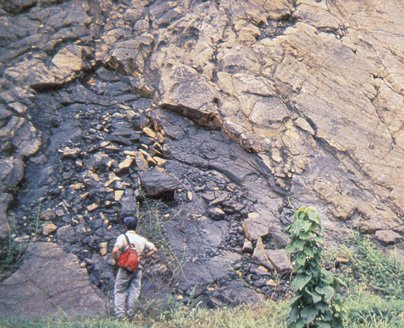
It turned out that nature had produced her own nuclear reactors. Deposits of uranium were located in river beds. When the water soaked into the rock it acted as a moderator, slowing the neutrons produced by the uranium’s radioactive decay sufficiently to allow them to hit other uranium atoms, causing them to fission in turn and thus producing a sustainable chain reaction. In other words, a naturally occurring nuclear reactor. As the reactor ran it produced heat which boiled off the water causing the reaction to cease until the pile cooled down enough for more water to soak in. Whereupon, the whole process started again. The reactors ran for hundreds of thousands of years, possibly as much as a million years.
All this took place about two billion years ago. The area is of course perfectly safe and has no more radiation than the normal background. When I first heard about Oklo there was only one site identified, with the possibility of another two nearby. Since then, another 14 reactors have been identified, so they are hardly a million to one fluke. It is unlikely that any new reactors will start because the natural (that word again) different rates of decay of uranium isotopes means that the amount of 235Uis slowly decreasing to below the limit required for a sustainable chain reaction. Like insulin, if we want any more reactors we will have to make them ourselves.
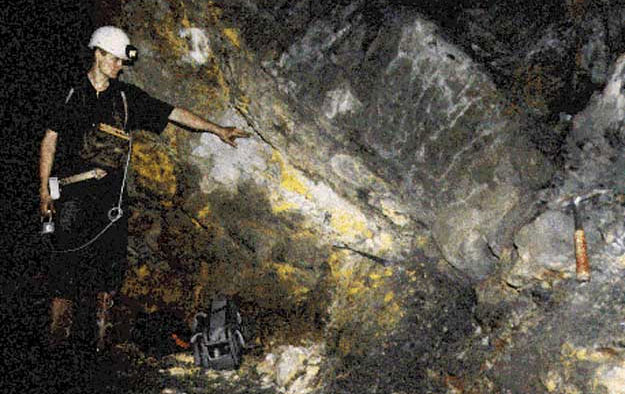
So, nuclear reactors are natural after all. Will the W2U2W3 embrace them now, along with the hair care products? What do you think? But at least they might reconsider the appeal to nature fallacy the next time it appears on TV or in a glossy magazine.
PS. While we are questioning the mythology around nuclear power, it is worth remembering that plutonium may stick around for a long time, but mercury, arsenic and lead, all of which are highly toxic, are here forever!
[1] That’s fallacious, not fellatious, although I’d consider felonious. Also, you know it’s not Paltry 😉
[2] Ever heard of global warming? Nuclear produces virtually no CO2.